People are asking me why I am doing my thesis-and-beyond work to benefit Iraqi widows even though I am not Iraqi, knew no Iraqis personally when beginning this work, and have never been in a war.
I answer in a lot of ways: about my previous work, my outrage at injustice, global society where we are all neighbors, my formative years watching the Vietnam war and so on.
I woke up at 1:30AM thinking of a very old story in a new light. When I was a boy - maybe 2nd or 4th grade - some argument ensued, resulting in me being tied for a time to a telephone pole. I do not remember exactly what it was about, how long i was there (not long), or -most importantly - how it felt. But I can never forget that my brother never forgave himself for letting his friends do that to me, and not stopping them. He didn't help them or encourage them, but he didn't stop them. I did not blame him, but he never forgot.
I don't want my life to continue without doing something to stop injustice. I just have trouble sleeping knowing that I haven't tried, when I have the opportunity. Sometimes circumstances peresent themselves and we have to choose to participate or pass. No one can fix everything, and not everything can be fixed, but it is the trying, the effort, the caring that makes life a little more worth living. This is the opportunity. I have the statement, the time, the support, to do this and so I must.
Monday, November 30, 2009


Wednesday, November 18, 2009
Francis Alys: When Faith Moves Mountains 2002
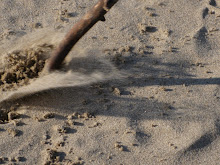
Just ran across Francis Alys, whose work When Faith Moves Mountains in 2002 involved five hundred people living in a shanty town outside Lima, Peru using shovels, one step at a time, to move a dune 4 inches. They live in these dunes along with about 75,000 people without running water or electricity.
His words: attempts to translate social tensions into narratives that in turn intervene in the imaginal landscape of a place. The action is meant to infiltrate the local history and mythology...
art operates precisely within the space of myth....
In this sense, myth is not about the veneration of ideals--of pagan gods or political ideology--but rather an active interpretive practice performed by the audience, who must give the work its meaning and its social value.

Thursday, November 12, 2009
Lines in the Sand for US Casualties


Wednesday, November 11, 2009
Veteran's Day

Tuesday, November 10, 2009
Black Rain
Jaber Alturfee found my Black Rain video, which is on youtube at Bodyrewired. He said that it was very moving and sad, reminding him of the end of the 1991 Persian Gulf war, when the US and Iraqi troops were kicking up so much dust and there was a sandstorm that left black soot all over the city for two weeks. He wasn't sure what the Black was from, the bombing, the oil and other contamination or what, but that the whole city was black until the next rain, maybe two weeks later. He showed the video to his whole family.
Sunday, November 8, 2009
Interview Without Audio
I guess we all make mistakes sometimes. I brought a Zoom recorder, and Lav and a Beta57a, but I didn't use any of them for a short debrief after our performance. And of course our Camera's phantom power switch got switched off in the case. So I have video, but not audio of the discussion.
I asked if anyone had responses to the performing of the drawing of lines in the sand, and I think everyone felt some connection, to each other, to widows in Iraq, to the bystanders at the beach. Matt said that at first he was thinking of widows being older women, but that after a while it dawned on him that many of the widows in Iraq are young, probably his age. I think Sarah concurred. Jaber said that it was true and that the widows came in all ages and having different economic status, and that it was very difficult, for them and their children.
We also talked about how at times we were concentrating on the counting of the lines, but how it eventually became more of a meditation. Jabur said that he was thinking about the faces of women he worked with in Iraq, and the promises he made to help them. He has hope that together we can make a difference for these women. He said that he had trouble not tearing up.
We all felt that this was moving, worthwhile and should be expanded.
Saturday, November 7, 2009
Widows: Lines in the Sand 11/7/09 Action Day
Today was the first group performance of Widows: Lines in the Sand. Core Project in conjunction with Bodyrewired and Jaber Alturfee performed and documented on the 31st Beach, covering a large portion of the beach with lines memorializing the repetitive labor of widows in Iraq. We drew over ten thousand lines collectively while imagining (or in Jabur's case remembering the faces) of widows in desperate need of aid, stability or hope. Many people stopped to ask us why and what we were doing, and we received a variety of responses from curious to supportive. I have yet to encounter an angry response.


Wednesday, November 4, 2009
Busy, Busy
Too busy to blog right now. Since last:
- still have to review critique tape
- Went to MCA and talked with Esam Pasha, a student named Majd, and Allen Turner
- Met with Jabur on Monday and talked about projects and life for both of us
- Met with Paul about registration
- Thesis class Critique
- Planned collaborative performance with Core Project and Body Rewired for Saturday
- Created Emily Jacir homage, installed during Art as Spiritual Pracice
- Met with Laurie N. about work, not-for-profit, and catch-up
Saturday, October 31, 2009
Thesis Colaboration Idea
Kelly suggested that I have a sort of raise-money-for-charity pledge system as one of my events in the installation, where people pledge a cent per line or so, and collected pledges are brought in and a certain number of lines are drawn (1000 = $10)
Thesis Critique
Critiques went well, very smoothly. I showed video of chalk and sand pieces, talked about the why, the how etc... I talked about the project and the exhibit. I asked some logistical questions about the installation. We also had a debate about how to raise the money for the widows - should I start a 501(c)3 or look for Fiscal Sponsorship?
10/20 Crit Rehearsal/10/21 Thesis Committee Meeting
What I left out of presentation:
Why 3 million?
Why 3 million squares?
show project manifestations?
Talked with Mel and Paul next day 10/21:
I showed them my presentation and talked about some of the changes I wanted to make including adding more backstory to my project, revamping the video (cleaning up), and showing video at the appropriate times, not at the beginning.
10/24 Jaber Alturfee & Ahlam Ahmed Mahmoud
Back at the Jeremy Deller exhibit at the MCA, I was visiting with Jaber Alturfee with Ahlam acting as translator. I listened more this week, as he talked to people. He was saying that if the Americans pul out now, they are only half done training the security forces (military, police). Democracy takes time. After the 2003 invasion, there used to be meetings of leaders from around the country to talk about shaping the future of Iraq, but they had all stopped before he left in 2008. He noted that the defense agreement between the US and Iraq was for defense from foriegn invaders - or he might have said that it should be - and that there is a great need to build up a civil society. He stated that the security now is better than it was 3-4 yrs ago.
We talked about meeting to see what is suitable, what can be done for widows in Iraq. He said that we need to sit together and think about who to help and what their need is.
We talked about meeting to see what is suitable, what can be done for widows in Iraq. He said that we need to sit together and think about who to help and what their need is.
Friday, October 30, 2009
Conceptual Art
Lying in bed this morning, when I should be asleep, I realized that my work has always been conceptual art. I've done my share of landscapes, architectural and figurative work, but all my series have been conceptual. It also occurred to me that my thesis proposal is basically an enlarged Cabinet, I just never saw it that way. Now I have to make a Widows Cabinet.
My mind has been spinning all week with ideas.
My mind has been spinning all week with ideas.
Friday, October 23, 2009
10/17: Ahlam Ahmed Mahmoud al Al-Jabouri and Beth Ann Toupin
Ahlam Ahmed Mahmoud al Al-Jabouri and Beth Ann Toupin, co-founders of the Iraqi Mutual Aid Society Chicago, were at Jeremy Deller's It is what it is exhibit talking about Iraq, refugees going first to Syria then to Chicago. We talked about their work helping settle refugees who know little of our culture, even if they know the language, which about half do by their estimates. They said that most of our culture they pick up from prime-time TV, so when Ahlam's relatives knew she was in Chicago, they asked if there are a lot of gangs around.
They both explained that when they arrive in Syria, where most of the refugees are because their border remains open to refugees headed to the UN camps, they put their names on the list and about a quarter of them get resettled, with many coming to Chicago, settling in Rodgers Park and Edgewater. They get one month's rent, a bed (cot) per person, a blanket, a fork, a knife, a plate and a piece of furniture for the living room (can be a plastic chair). They get a little money, much of which goes to rent deposit and some overhead for the agency that settles them and buys the items. The Iraqi Mutual Aid Society tries to cook them a meal when they first arrive, and get them donated items they might need like winter coats or sofas etc....
They estimated that 17,000 refugees arrive per year, and about 1400 arrive in Chicago. There are 2,000,000 refugees in Syria. As of yet, their group has no funding, just volunteers, and a donated space to store furniture and clothes. Ahlam said that in Rodgers Park and Edgewater there are about 5 or 6 Iraqi families in a single block. Beth said that adapting to the culture is challenging. One of the first things they tell them is not to bribe the police. If you get stopped for a traffic violation in Iraq, the first thing you do is reach for your wallet, so the police know that you will pay them. Not such a good idea in Chicago. But Ahlam said that the police have really helped her twice already. The first night she was here, she went out to get an item at the store, and couldn't find her way home. She flagged down a cop who drove her around the neighborhood till she recognized where she was at.
Beth talked about how educated refugees sometimes find it harder to adjust because they might have had a great profession in Iraq, and working sweeping floors for $7 dollars an hour is such a shock to a skilled doctor or architect, for instance.
We also talked about life in Iraq. In the exhibit their is an actual car, mangled from a car bomb and burnt and rusty. There are also photos of an historic street market where people come to sell books that they may have read, and to buy books they have not read yet. There is a before picture, a bombed picture - where one cannot tell that it is even a street - and a new picture of it rebuilt. Ahlam said that you have no idea when you are told that there was a car bomb, what scale that means. These things are extremely destructive. Twice, she told us, she was a block or more away. First thing is that you cannot hear, and your ears start to bleed. Then you can't smell or breath from your nose for the smoke. Then your head hurts like a migraine due to the concussive power of the bomb.
We talked about charities in Iraq and the widows. Only the small charities and NGO's are left, ones that don't need insurance. Even Amnesty International and Human Rights Watch have pulled out.
The challenge is even more acute in the countryside. Women there are stuck with their relatives and there is no aid or charity working in those areas.
Subscribe to:
Posts (Atom)